Click on this image to order the book

Click on this image to order the book
The book version of James Gammell's life story is now available. Click on this image.

Friday, November 11, 2011

A Letter to Margaret Jane

It was New Year’s Day 1870.  James sat down with pen and paper to write his annual letter to his sister, Jane.  After an absence of thirteen months working on the railroad, he was ready for a rest, a home-cooked meal, and a peaceful homecoming around the hearth with Maria and the children.  A bottle of Scotch whiskey also added to his reflective, nostalgic mood:

My dear sister Jane,
…know that warm harts and true friends still thinks of you and yours tho o’re the hills and far away…this gold Scotch…brings fresh to my mind the days of old lang-sine and many a pleasant reckolechion which can [never be] realized again for but few of the actors of our old play days remanes yet…I can think back on our Childhood with many a pleasant recklection which often drives the dull care of the present away.

He goes on to tell Jane that he was on the Bear River and far from the settlements when he received her letter informing him of the death of his brother William, who had died unexpectedly in April of pneumonia.  “Jane, it was a hard blow…dear, dear brothers, they are both gone.”  He reminds her that they are the only two left of the siblings that once bore the Gammell/Gemmell name.  William, Robert and Andy have all died, as well as their half brother Fred Wylie.  Henry Wylie is living in Massachusetts, and their half sister Mary is still living in Texas.

James had hoped to visit Jane in Houston before his return to Sheridan, but he had been gone from home long enough.  The last time he had seen her was when they said goodbye on the Houston Bridge as James was leaving Texas in May 1857.  Jane’s first husband, Captain James Andrews, was with them at that last parting, but he died the next year at age fifty.  James had fond memories of “the Captain,” as they called him:

…the Captain, poore fellow, many a plesent reckliction I have of him, one of the most noble of Gods works…Generous to a fault.  Yes Jane as I set and Look at your Pictor with that of your family and thinking of those that gone it makes me feel chills I almost fancey that I can feele the warm kiss and fond imbrace at the Last adieu on the Houston Bridge the holy warm kiss of A sisters love makes A deep impreshion upon the hart that never can be iraddecated the adieus of you all at that parting is the fondest treasure of my bosom and the greatest regreat at the present is that I can’t be one of your family circle on this annual festival of the new yeare and fill the invitation that William gave A year ago  That dear Jane, would be one of the happiest days of my life but we know that today if we can’t mingle in your midst that we are still in your minds and wishes us as we do you A happy New yeare and many of them but as you say it can’t be A verry happy one for it must bring my recklections of the past and the recent [death] of many of our family will be sadly missed but so my dear sister is the destiny of man we must all shortly follow  Let us be prepared for that Grand and certain event that we may meete it as our Brother did when you asked him if he had any thing to say to Jim he looked at you with A smile as much as to say, all is right.(1)

James also expresses his sympathy for William’s widow (also named Jane), for her grief and her loneliness:  “Poore Jane, the loss of a bosom Companion that we have lived so many years with…is like tearing the sole from the body…I do regret that they had no Children to bare with her their burdon of greefe and Cheer her declining years.”

Thinking about his own mortality, James can’t help but feel grateful for the progeny that he will leave behind:  “…with me Jane, it will be different for when this old hulk is layed Away there will be a lot left to laugh or cry as they may feele.”  On this New Year’s day (1870) he can count eight children that are living with him in Sheridan:  Orlin, Jeanette, Josephine, James, Charley, Andrew, Virginia, and Alice.  “They are at present going to [school]…and Jane, I am proud of them.  They are all smart and will pass in a Crowde.”

He doesn’t forget to mention his children who are not living in Sheridan.  “My oldest daughter whose mother died in Salt Lake is married and got one Child.  She has done well…no [polygamy] for her…I made my home at Liby’s [while working on the railroad in northern Utah] and had A great time with my Grand daughter.”  And as for Hannah Jane’s children, “My other children with their mother home I left in Utah are all well.  I have not saw them for seven years but hear oft from them.”

James adds a few concluding remarks.  He states, “Mormonism is About played out… there is many divisions of them here.” (*)   He mentions Eleanor Pratt, who is opening a school in Salt Lake City and doing well.  And finally, he tells his sister Jane that he will shortly write to William’s widow, Jane, to Andrew’s widow, Hetty, and to his half sister, Mary Wylie Gregg.  “Well [Jane] I have given you a long letter.  Try and pay it back with interest.  Give my Love to all.  So says Uncle Jim Gemmell.”

(*) Note – If by “played out” James meant that Mormonism had run its course or reached its peak, and was then [1870] in decline, here are the actual statistics:  Church membership in 1869 was nearly eighty-nine thousand.  Total membership at the end of 2010 was over fourteen million. The Church of Jesus Christ of Latter-day Saints is presently the fourth largest Christian denomination in the United States.
_____________________________
  1. Jim Gemmell , letter to his sister, Jane, January 1, 1870.  (Courtesy of Patricia Riddell Lococo.)

Monday, October 24, 2011

Settling in Ruby Valley

Image courtesy of the Friends of the Sheridan Library


Sheridan is known as the "heart of the Ruby Valley".  This peaceful valley is surrounded by seven majestic mountain ranges (Tobacco Root, Ruby, Highland, McCartney, Pioneer, Gravelly, and Snowcrest mountain ranges).  James and Maria and their five children arrived by wagon from Salt Lake City in May 1865, and settled on a one hundred sixty acre ranch just west of town.  Two months later on July 10, their daughter Virginia was born. She was said to be one of the first white babies born in the vicinity of Sheridan.(1)

Once Orlin Gammell had learned that his father was living in Sheridan, he made plans to join him there.  James had not seen his firstborn son since the boy was four years old.  Since the death of his mother, Harriet, Orlin had lived with his uncle, John Fitzgerald, in Spring Arbor, Michigan.  At age nineteen, he was ready to strike out on his own.  First he made his way to Omaha, where the Forbes and Brown freight company hired him to drive the grub wagon.  The outfit of twenty-six wagons, each drawn by four yolk of oxen, started west on May 12, 1866.  Three hundred miles east of Salt Lake City, Orlin fell ill with mountain fever.  At that point he left the wagon train and made the rest of the journey to Salt Lake by stagecoach, and spent a few weeks in the army hospital at Camp Douglas.  On October 8, he was well enough to join another freight outfit bound for Virginia City.  When the wagon train reached its destination on November 11, Orlin walked the rest of the way to Sheridan.(2)


Map of Ruby Valley, Montana
Courtesy  of 
http://www.rubyvalleylodge.com/

Upon his arrival he started working with his father at the sawmill on Mill Creek, hauling logs and sawing them into lumber for the floors and interior finishes of the old Robber’s Roost building, a roadhouse between Alder and Sheridan.  That same winter (1866-67) James and Orlin built the family home with sawed square logs they had cut at the mill.  The home stood for many years on the site of the present [1976] Sheridan Gun Club.  In April, James and Maria’s daughter Alice was born in the new log house, which was located in the northern part of Sheridan.  The next year (1868) father and son sawed the lumber and built a barn not far from the log house.  It was so large that it soon became recognized as the largest barn in Montana.  When it was finished, James invited the residents of Sheridan, and all of Madison County, for that matter, to help celebrate its completion with a dance.  People came from all over Montana to help christen the "Big Red Barn".  They came from Yellowstone, Virginia City, Bannack, and other far distant points for what was considered the social event of Territorial days.(3)

Now, three years after their arrival, Maria and the children were beginning to feel comfortable in Sheridan, though, as her daughter Virginia recalled, Maria was still wary to speak about the Mormons:

Mother was reticent regarding her family possibly for the same reason in part that Uncle James [father] was.  In those days everyone seemed very diffident about speaking of their relations to the Mormons or the church. Mother never talked of her home life much or little incidents of her trip across the plains.  I don’t even know just how old she was, but conclude she must have been well in her teens for she has spoken of a man to whom she was engaged to be married when she left the east [Iowa].(4)

Maria’s children acknowledged that, in spite of her reticence to speak of her Mormon faith, “only a few days before her death, she expressed her belief in the tenets of that religion.”(5)

At the same time that his family was adjusting well to new surroundings, James was growing restless.  As he told his sister, Jane, “but times was dull here and I must have excitement.”  Maria and the children were not at all pleased with his plans to leave for Bear River.  They told him he had no need to go.  In spite of their objections, he left Sheridan in early December 1868, crossed the Continental Divide before the snow depth would close the pass for the winter, and made his way to Utah.  For the next year he worked in the lumbering business for the railroad on the Bear River near the border of Utah and Idaho.  He loved to be where the action was, and, as he had done so many times before, he chose the right location.  The eyes of the whole nation were on this out-of-the- way spot in northern Utah.


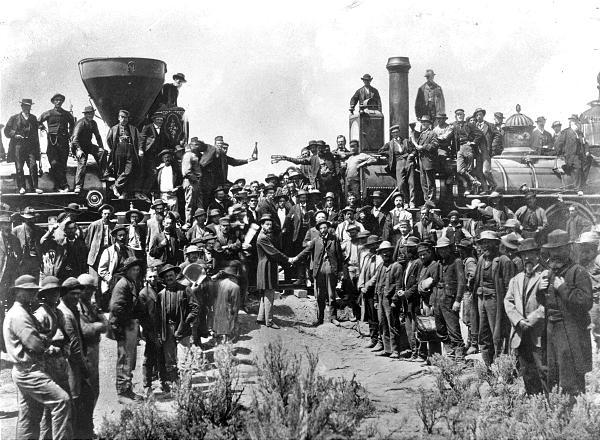
Promontory Summit, Utah, May 10, 1869
This iconic image captured by A.J. Russell is one
of the most famous photographs in American history.
from Deseret News archives

By spring the transcontinental railroad was completed with the joining of the Central Pacific and Union Pacific Railways on May 10, 1869.  Most likely James was present for the simple ceremony at Promontory Summit, Utah, where dignitaries, railroad workers, and spectators celebrated this historic event.  After prayers, speeches, and the placement of the last rails, dignitaries took turns tapping four gold and silver spikes into a pre-drilled laurel wood tie specially made for the ceremony.  The crowd cheered as the news was flashed over the telegraph.  Photographer A. J. Russell captured the iconic image that has become one of the most famous photographs in American history, and the Deseret News captured the story:

The last tie has been laid; the last rail is placed in position, and the last spike driven, which binds the Atlantic and Pacific ocean with an iron band.  The electric flash has borne the tidings to the world and it now devolves upon us, the favored eye-witnesses of the momentous feat, to enter our record of the facts.  Never before has this continent disclosed anything bearing comparison with it.  The massive oaken-hued trains of the Central lies upon their iron path, confronted by the elegant coaches of the Union Pacific.  A thousand throbbing hearts impulsively beat to the motion of the trains as the front locomotives of each Company led on majestically up to the very verge of the narrow break between the lines, where, in a few moments was to be consummated the nuptial rites uniting the gorgeous east and the imperial west of America, with the indissoluble seal of inter-oceanic commerce …The excitement of this moment of victory was intense, cheers were given for the officers of the Central, followed by cheers for the officers of the Union Pacific; cheers for the Star Spangled Banner, for the President of the United States, for the engineers and contractors and for the laborers that have done the work.(6)


Drusilla Hendricks, her granddaughter
Elizabeth (Libby) Gammell, and Libby's
husband, Eli Harris.
c. 1868

During much of that year spent in Utah, James made his home in Richmond with his daughter Libby.  He had seen her but a few times in the past eighteen years.  Libby had no memory of her mother, Elizabeth Hendricks, who had died when Libby was just three months old.  In her childhood she moved with her maternal grandparents to Richmond in Cache Valley, and at age sixteen she married Eli Harris.  While lodging with his daughter and son-in-law, James especially enjoyed spending time with his first grandchild, Drusilla Elizabeth, who would be a year old in September.

James returned to Sheridan on December 31, 1869, with more than five thousand dollars to show for his labor.  In addition to the cash, he had hopes for another venture which could yield a profit: “I think yet there is some bit [of] Luck for me in store for I found a big coal bank thirty miles from the rale rode…if good will be a big fortune.  I will soon know.”(7)
________________________
  1. Obituary of Virginia Gemmell Garrity, The Montana Standard, Butte, Montana, 8 January 1942.
  2. Carey, Dorothy Ellinghouse, Pioneer Trails and Trials, p. 468, Madison County History Association, 1976.
  3. Carey, Dorothy Ellinghouse, Pioneer Trails and Trials, p. 468. “The Pioneers,” Madison County History Association. Duncan, Elaine, ”An Adventurous Pioneer”, 1926. (The barn was demolished in 1913 by the new property owner E.D. Marsh.)
  4. Virginia Garrity’s letter to R.V. Chamberlin, 1922.
  5. Obituary of Mrs. Susan M. Gemmell, The Madisonian, 8 February 1896. p. 8.
  6. Deseret News, May 19, 1869.
  7. Jim Gemmell , letter to his sister, Jane, January 1, 1870.

Monday, October 17, 2011

The Parting of Two Families

The sawmill business proved profitable for James that first year (1863-64).  Some say he made a small fortune.  This seemed like a good time to move his family to Montana and to settle there permanently, however, there were some drawbacks.  The gold rush era was the most dangerous, lawless period of Montana’s history.  Bandits and road agents controlled the road between Bannack and Virginia City, targeting travelers journeying between the two mining camps.  Violent holdups became commonplace.  In 1863 alone, about a hundred men were murdered.  James would have been a likely target, traveling as he did with either a load of supplies or a large sum of money.  The law was enforced and justice dispensed by the self-appointed Montana vigilantes, and it was often hard to tell which group was more corrupt, the bandits or the vigilantes.  James reportedly knew many of them, bandits and vigilantes.  A suspected road agent named Reed (Erastus "Red") Yager was said to be sleeping in the same bed with James when he was taken by the vigilantes and hanged on a tree near Laurin, a few miles from Sheridan.(1)  The sheriff himself, Henry Plummer, was also a suspect.  He and two members of his so-called “Plummer Gang” were dispatched at the end of a rope on January 4, 1864, on the very gallows Henry had built.(2)

In spring 1864, once the sawmill business was up and thriving again, James returned to Utah and informed his family it was time to move to Montana.  It would be a difficult task for any man to break such news to one wife and one family of children, but how about two?  Too bad we don’t have a detailed account of that “family council”.

It’s probably safe to assume that Hannah Jane flatly refused to go.  She had always been a devoted member of The Church of Jesus Christ of Latter-day Saints, and she had strong ties to the community and to her siblings who lived nearby.  James’ disaffection from the Church probably took its toll on their relationship.  (During the six years since his excommunication from the Church, he could have applied for readmission, but he obviously chose not to do so.)  Most likely James didn’t even ask Jane to go to Montana.  He knew how she felt, and he also knew that settling in Montana with two wives and two families would have been unwise, to say the least.  At this point their marriage ended.  Jane, who had worked hard during those lean years at various odd jobs, like doing washing and ironing for the soldiers at Camp Floyd to help support the family, would now need to support her children on her own.(3)

Although Maria had a more amiable relationship with James, this would not have been an easy move for her either.  It would mean leaving her mother and her brothers, who lived nearby.  It would mean hard work and backbreaking labor to establish and build a new home on the frontier.

In spring 1865, James and Maria loaded up a covered wagon with five children (Nettie, Jodie, Jimmie, Charlie, and Andy), all their belongings, and supplies for a journey of several weeks.  Little five-year-old Robert (Hannah Jane’s youngest son) said good-bye to his father, and never saw him again.  Consequently, in later years Robert told his own children that he didn’t remember much about his father.  He said that his mother told him that Father left home to go on a freighting trip.  When he didn’t return, “Mother told them that the Indians must have killed him, as he had to carry large sums of money.”(4)  Ironically, this is precisely what happened to her first husband, Isaac Brown, father of Isaac and Hannah.  It seems more logical to assume that, rather than lying to her children about their father, Jane never mentioned his name again, leaving young Robert to believe that stories told about Isaac Brown, were about his father, James.  After James left, Jane dropped the Gammell name and went by Hannah Jane Brown.
_____________________________
  1. James Gemmell obituary, The Dillon Tribune, April 9, 1881. Reed (Erastus “Red” Yager), along with George Brown, was hanged from a cottonwood tree, which still stands outside of Laurin.
  2. http://www.legendsofamerica.com/mt-henryplummer.html
  3. A short biography of Robert Mahlon Gammell by his daughter Charlotte Gammell Jensen.
  4. A short biography of Robert Mahlon Gammell by his daughter Charlotte Gammell Jensen.

Friday, October 14, 2011

Dedication of a new William Gammell Plaque in Houston

A message from the San Jacinto descendants organization:

Liz,
I wondered if you, or any of your family has been contacted about the Ceremony at Washington Cemetery in Houston, on October 22, 2011.  I just thought it would be wonderful if some of William's cousins could attend.  You have the Monument in Founders Memorial Park still pictured on your blog and since they now know that William is not really buried there, I thought you should include a new photo of the plaque they will unveil on the 22nd.

Robert "Scott" Patrick
President General Elect, San Jacinto Descendants
SAR, SRT, SCV, SJD, HOSBD

If any relatives of William Gammell would like to attend this ceremony on October 22, 2011, please RSVP to the name and address at the bottom of the invitation.


Click the links below to view the new monument for William Gammell.  The marker was erected in 2009 by the Texas Centennial Commission to correct mistakes that appeared on the original 1936 monument.  The dedication ceremony was held October 22, 2011, and the photo was taken on November 28, 2011. 

http://www.flickr.com/photos/texashistoricalmarkers/6435815855/sizes/l/in/photostream/

http://harriscountyhistoricalmarkers.com/HistoricalSites/CurrentMarkers.aspx?udt_1462_param_detail=1224

Friday, September 30, 2011

Gemmell's Sawmill - Sheridan, Montana

James loved southwestern Montana better than any other place on the frontier.  Nearly twenty years had passed since his first expedition with old Jim Bridger, but he had returned time and time again during those years.  It's no wonder that he eventually chose Ruby Valley as his permanent home.

He loved to recount his Montana adventures and describe the pristine wonders of nature that few white men had ever seen.  Memories of his first visit to the region were still vivid in his mind when he described them to William Wheeler in 1879:

…wonderful spouting springs at the head of the Madison and…what have of late years become so famous as the Upper and Lower Geyser Basin, the Upper and Lower Falls…and the Mammoth Hot Spring…Here we camped several days to enjoy the baths and to recuperate our animals… We made winter camp at the mouth of the Big Horn, where we had a big trade with the Crow and Sioux Indians.  The next spring we returned with our furs and robes.(1)

As early as 1850 James went on trading expeditions up the Snake River, and as far as the Bitter Root or St. Mary's River among the Flathead Indians in Missoula County.  He camped at Alder Gulch on the very sight where rich gold discoveries were made twelve years later, discoveries that led to one of the largest gold booms in history.  “Not once did he have an idea of the great gold harvest that lay beneath him, but he saw only the beautiful and luxuriant furs and robes of the beaver, which he accumulated year after year and sent to St. Louis by way of Fort Bridger.”(2)

James made many such trading trips to Montana in the years preceding the gold rush.  He entered the fertile Ruby Valley with a party of five men and packhorses in the fall of 1857, and traded with the Indians.  They camped at the mouth of Daylight Gulch near Virginia City, where they met a trapper named Robert Dempsey.  James went down into the Yellowstone region and traded blankets for furs with the Indians.  When he returned to the valley, the snow was so deep that he was compelled to spend the winter at Dempsey’s camp and to postpone his return to Utah until spring.  There was no forage for the stock, and they had to cut cottonwood boughs as feed for the mules…that was all the feed those poor animals had to live on through the long winter.  The hardship and privations of that winter (1857-58) forged a life-long friendship between James and Robert Dempsey.  (Dempsey and his Indian wife, who was adept in the white woman’s manner of dress and housekeeping, became good friends of James and Maria when they later moved to Sheridan.)(3)

In spring 1863, during his second expedition from Utah to the Bannack gold mines, James headed northeast to Fort Benton, a trading post on the upper Missouri River, to trade with the Indians.(4)  While he was there, he purchased the sawmill machinery that was used to cut the lumber for the fort, loaded it in his wagon, and started back to Alder Gulch.  When he was one day out from Fort Benton, the Indians stole his mules.(5) Refusing to accept his misfortune, yet not wanting to antagonize the culprits, he came up with a solution.  He went back to Fort Benton, purchased five gallons of whiskey, and traded it to the Indians for his stolen mules.  Upon his return to Alder Gulch in October he met Joseph C. Walker, who had recently settled in Montana.  The two men (along with Walker’s brother and cousin) went into business and constructed a sawmill on a creek near Sheridan that became known as Mill Creek.(6)


Possible site of Gemmell's sawmill
in Brandon, Montana, just a few miles east of Sheridan
Photo by Bary Gammell

Brandon is located on Mill Creek just east of Sheridan


It took twelve mules to run the new mill, plus a crew of twelve men.  The fee charged for the unfinished lumber was twenty-five cents per foot.  (Profits in that first year were enough that Joseph Walker agreed to pay off James’ long overdue debt ($500 for goods on credit) to the Walker brothers of Salt Lake City.)  The mill crew worked hard all day, but during those long winter evenings, with nothing to read, they passed the time sitting around the fire telling stories.  Five members of the crew were James’ acquaintances from Utah, so most often the conversation turned to berating the Mormons, specifically Brigham Young.  James, at one time, had a cordial personal relationship with Brigham Young, but later, especially after his disaffection from the Church, James seemed bent on knocking the revered prophet down a notch or two.

Years later Walker recorded what he could remember of “the acts of the Mormons during those early years” as told to the crew by Gemmell during the long evenings at their camp on Mill Creek (twenty five miles from Virginia City, in the winter of 1863-4.)  Like most mountain men, James surely had developed the gift of gab, for as Walker declared, “I have penned but a tithe of the history he [James] gave.”  According to Joseph Walker, James told the crew how he made the decision to come to Alder Gulch.  Two of the few confidential friends that he had left among the Mormons seemed to think that

…it wasn’t safe for him to sleep in his house [because Brigham was "down on him"]...[James] said that he spent the days with his families, and hid and slept in the brush at night, but he said he could not make a living for two families and live that way.  So he got some Indian goods from the three Walker brothers [not Joseph C. Walker] on credit and with two old wagons and some Spanish mules he struck out north in the early spring of 1863 coming up through Bannack…(7)

Although Joseph Walker’s business partnership with James lasted only a year, he retained fond memories of those days, and recorded this final tribute:

…during the year Mr. Gemmell was associated in partnership with my brother A. M. Hardenbrook and myself, no partnership could have been more agreeable.  Many years ago Mr. Gemmell went to his reward.  Peace to his ashes.  He had worked upon the treadmill of life enough.  His body was interned on Mill Creek about eight miles below our winter camp of 1863-4.(8)

Walker and Gemmell saw each other for the last time in fall 1865 at Virginia City, not long after James had moved his family to nearby Ruby Valley.  At that reunion, James was eager to tell Walker about his long conversation with General Thomas Francis Meagher (pronounced "Mahr"), newly appointed acting governor of Montana Territory, who had just arrived in Virginia City, the territory’s new capital.  James reported that he and Meagher chatted for hours, comparing notes about the experiences they had in common.  Both of these men had led very colorful lives, both had been prisoners in the British penal colony at Van Diemen’s Land, both had escaped on American whaling vessels, and both had made a home in Montana that same year.(9)  Meagher, a Union officer in the Civil War, was born in Ireland.  As a young leader in the Irish rebellion, he was arrested and sentenced to life imprisonment in Van Diemen’s Land, but made his escape in 1852. James, who was captured in the Canadian rebellion, had escaped the island seven years before Meagher arrived, but he had learned about Meagher through newspaper reports. Just two years after his conversation with the general, James was shocked to read about his tragic death: “…suddenly in the summer of 1867, after beating the odds time and again on three different continents, Thomas Francis Meagher fell off a riverboat (at Fort Benton) and drowned in the Missouri River at age 44.  His body was never found.”(10)
________________________
  1. Wheeler, p. 331.
  2. Duncan, Elaine, “An Adventurous Pioneer,” 1926. (Elaine Ducan, great granddaughter of James Gammell, wrote this article when she was sixteen years old.)
  3. Montana Historical Society, “The Pioneers”, author unknown. 
  4. Larry Preston, in his 1956 paper on James Gemmell (pp. 17-18), cited an oral tradition passed down by family members.  As the story goes, James’ daughter Jeanette accompanied him on the trading expedition in spring 1863 from Salt Lake to Ruby Valley, Alder Gulch, and the Yellowstone region. There are many questionable aspects to the story; therefore it is not included here. To name just two, Jeanette would have been just eleven years old at the time…very young for such a dangerous trip. Also, James spent the winter in camp with his mill crew, before returning to Salt Lake Valley.
  5. Montana Historical Society, “The Pioneers”, author unknown.
  6. Walker, Joseph C., pp. 40-41, 64-65.
  7. Walker, Joseph C. pp. 40-42, 64-66. See also “The Pioneers”, author unknown.
  8. Walker, Joseph C., p.65.
  9. Walker, Joseph C., pp. 65-66.
  10. http://www.ricksteves.com/plan/destinations/ireland/meagher.htm    General Meagher’s statue still stands in front of the state capitol building in Helena.  

Tuesday, September 20, 2011

Family Photos - James Gemmell's children in Montana

Old photos are such a treasure!   Here are three taken in Sheridan, Montana.  They were published in a book called Pioneer Trails and Trials in 1976 by the Madison County History Association.
I would love to find out if anyone has the originals.


The Orlin Fitzgerald Gammell Family
 taken in Montana, c. 1910.
Orlin is James Gammell's firstborn son. 


The living children of James Gemmell (c. 1924), those who were living in Sheridan at the time.


George Gemmell, youngest son of James, and his son Billy, c. 1924,
 at George's blacksmith shop in Sheridan.

My next post will tell the story of  James' move to Montana.  (I will then move these photos ahead into other posts.)  

Thanks to Bary Gammell for providing these photos.

Sunday, September 11, 2011

The Montana Gold Rush

While the Civil War was raging in the United States, Utah Territory was enjoying a period of growth and increased prosperity.  The 1860’s brought an influx of 16,000 Mormon converts from Europe, who crossed the plains in ox trains.  With its population growing, Utah made its third petition for statehood.  Ironically, just as the Southern states “were trying to get out of the Union, Utah was trying to get in.”  Though the quest for statehood was an uphill battle, President Brigham Young reminded the Saints how blessed they were to live in the sheltered valleys of the west:

Had we not been persecuted, we would now be in the midst of the wars and bloodshed that are desolating the nation, instead of where we are, comfortably located in our peaceful dwellings in these silent, far off mountains and valleys. Instead of seeing my brethren comfortably seated around me today, many of them would be found in the front ranks on the battlefield.  I realize the blessings of God in our present safety.  We are greatly blessed, greatly favored and greatly exalted, while our enemies, who sought to destroy us, are being humbled.(1)

James Gammell, his wives, and children were among those blessed to be spared the tragedy that befell his brother Andrew at the Battle of Vickburg.  Andrew’s wife, Het, was left a widow and his three daughters orphans.  In a letter to his sister, Jane, James expressed his sorrow for the loss of his two brothers:

I was on the river and far from the settlements when I got your Letter with the account of William’s Death.  [William died of pneumonia in Houston.]…Jane, it was a hard blow… Dear, Dear Brothers, they are both gone.  Poore Andy fills a bluddy but noble grave...Oh William, could I but bin near to have soothed your last moments and mingled my tears with those that was present.  It would have bin a great satisfaction to me, but now I can but weape over fond reckelections of those dear ones… Give my love to all, so says Uncle Jim Gemmell.  I shall shortly write to…Hetty [Andrew’s wife].(2)

After the U.S. Army vacated Camp Floyd in fall 1861 to fight the Civil War, James found himself searching for new business opportunities to support his growing family—now eleven children.  His wife Maria had given birth to a daughter, Emily, in February of that year, but the baby lived only a few days.  One year later Maria had another child, named Andrew after James’ brother.

James didn’t have to wait more than a few months before he heard rumors of a promising new business venture.  In July 1862, gold was discovered in southwestern Montana on Grasshopper Creek, sparking the biggest rush since the California Gold Rush of 1848-49.  Word spread like wildfire, and the mining camp of Bannack(3) literally sprang up overnight.  By January more than four hundred prospectors were settled into their tents and makeshift shanties, waiting until the spring thaw would permit them to pan for gold.  Many of them had come ill prepared for the harsh Montana winter, and supplies were scarce.  The nearest source was Salt Lake City, four hundred thirty miles away.  The miners soon learned that no matter how much gold you have, you can’t eat it!  They were forced to pay dearly for imported supplies, and the freighters often made more money than the prospectors.


Route to the Montana Gold Mines
(approx. the same route as I-15 and Highway 91)

In November 1862, James loaded up two wagons with seventy one-hundred-pound bags of flour(4), some blankets, and other supplies that he had purchased on credit from the Walker brothers in Salt Lake City and started for Montana, confident that he could to sell his merchandise at “boom town” prices.  There is no evidence that James ever panned for gold himself; instead, he sold his goods to those who did, and likely relieved some prospectors of a good portion of their treasure. 

James was successful in finding a new and shorter route through Cache Valley to the newly discovered gold mines.  On this trip he headed due north from Salt Lake City, through the settlements of Richmond (Utah) and Franklin (Idaho).  Eight miles north of Franklin, he crossed the Bear River into Marsh Valley (present-day Bannock County, Idaho).  The new road turned out to be “an excellent one, with abundance of feed and water.”(5)

At Marsh Valley he met up with an outfit headed back to Salt Lake City from the Bannack City mining camp with the express mail.  At the Snake River crossing, three of the five men accidentally lost all their provisions and nine hundred dollars worth of gold dust in the river.  So destitute were they when they met Gammell’s train, they decided to return to the mines and try to recoup their losses.  They arrived there with James on December 17th.  After the three men turned back, the other two, George Clayton and Henry Bean, continued southward alone through Cache Valley on the very same route James had taken going north.  They were never seen again.

Montana freighter, A.H. Conover, who left Bannack City a few weeks after the Clayton-Bean outfit, discovered that the two men had been killed.  He was told by a group of Indians at the Port Neuf River, near Pocatello, that two white men with five animals (Clayton and Bean had five animals) were murdered near the head of Marsh Valley, not far from the Bear River and the Cache Valley settlements.  They said the Shoshone killed the men to avenge the blood of three of their band who had been executed a few days before by U.S. Army Major McGarry and his soldiers.  McGarry had confronted the Shoshone while rescuing a white boy who had been kidnapped from Cache Valley.(6)  There were several Indian attacks along this same route within the next few months, causing the U.S. Army regiment at Camp Douglas(7) to mount an expedition against the Shoshone in January 1863.(8)

Unusually mild weather permitted James to travel the four hundred mile route between Salt Lake City and Bannack three times that winter.  By the end of March (1863), James had sold his first load of goods at Bannack, returned to Salt Lake City, loaded up another pack train, and headed back to the mines.  Since business was booming at the camp, he increased the size of his pack train to fifteen or twenty animals, heavily laden with provisions and merchandise.  He started out with a company of about six men, but added several more when he passed through the frontier settlements.(9)

Jim Gammell was well known at the Bannack mines for his homemade whiskey, the antidote of choice for the drudgery and boredom of camp life.  We don’t know for sure how Jim made his brew, but this is one method typically used to stretch a barrel of whiskey: “to two barrels of water, one added a few plugs of tobacco, some camphor, and a little ‘stricknine’ to give it tang.”  This concoction was added to a barrel of whiskey, producing three barrels of “Red-eye” or “Mountain Dew.”(10)  Captain James Stuart, who organized a prospecting expedition for gold along the Yellowstone River, mentioned Jim in his journal:  “April 9, 1863…Our party started from Bannack City for the Fifteen-mile Creek (now known as Rattlesnake Creek)…At the time I left town the inhabitants were nearly all the worse for their experiments with Old Jim Gammell’s minie-rifle whiskey.”(11) 


Virginia City,Madison County, Montana
View from Cemetery Hill 2004
(Wikimedia Commons)

Bannack reached its peak population of nearly three thousand inhabitants in spring 1863, with nearly two thousand others living downstream.  The settlement dissolved as quickly as it had sprung up when another rich gold vein was discovered in May at Alder Gulch, eighty miles to the east.  The first prospectors on the new site took their gold to Bannack to purchase supplies.  Once they got a little whiskey under their belts, they couldn’t resist bragging that they had found the “mother lode.”  As the news spread, many prospectors pulled up stakes and headed for Alder Gulch, which soon became the thriving settlement of Virginia City.(12)  Alder Gulch yielded an estimated $30 million in placer gold(13) in just three short years between 1863 and 1866.  (Not to say that every prospector got rich there. The typical miner struggled to make a living wage, and ended up with more blisters, aches and pains, than he did gold.)

Business was booming in Alder Gulch, and future prospects looked promising. James decided to leave the Salt Lake Valley and settle in Sheridan, just twenty miles northwest of Virginia City.  When he moved his family to Montana in 1865, Virginia City was the largest town in the inland northwest, with a population of over ten thousand.  (The present-day (2010) population numbers, as the townsfolk say, “one hundred thirty-two very hardy souls!”)(14)
______________________
  1. Church History in the Fulness of Times, chapter 30.
  2. James Gemmell, letter to his sister, Jane, January 1, 1870.
  3. The ghost town of Bannack is now Bannack State Park, located just 24 miles southwest of Dillon. Take I-15 to exit 59 (State Highway 278), and travel west for 17 miles. Turn left on the Bannack Bench Road and travel south for 4 miles to the Park entrance on the left-hand side.
  4. Madsen, Brigham, North to Montana, p. 75.  Flour purchased in Salt Lake at $6 for a one hundred pound bag was sold in Montana for $40 a bag.
  5. Deseret News, “New Road North”, December 10, 1862. The new road followed roughly the same route as present-day Highway 91 and I-15.  (See also Joseph C. Walker, p. 64.)
  6. Deseret News, “More Indian Murders”, January 14, 1863.
  7. During the Civil War, the government sent seven hundred troops to Utah Territory to protect the overland mail and the transcontinental telegraph stations from Indian attacks. Instead of using the recently vacated Camp Floyd, they chose a site east of Salt Lake City and named it Camp Douglas after Stephen A. Douglas. The troops came in October 1862 and stayed until the end of the Civil War. ( See Church History in the Fulness of Times, Chapter 30.)
  8. The military action became known as the Bear River Massacre (about 250 Indians were killed).
  9. Deseret News, “Pack Train for the Mines, March 25, 1863.
  10. Madsen, Brigham, North to Montana, p. 27.
  11. The Journal of Captain James Stuart, with notes by Samuel T. Hauser and Granville Stuart.  (See “The Yellowstone Expedition of 1863”, Historical Society of Montana 1876, Vol. 1, p. 149.)
  12. http://www.legendsofamerica.com/mt-virginiacity.html   The majority of avowed secessionists living in the camp, which was then part of Idaho Territory and therefore "belonging" to the Union, made it primarily a "southern” town, with its residents’ sympathies lying with the Confederates. Furthermore, the camp was producing enough gold to win the Civil War for whoever could capture it. Due to this strategic position, President Lincoln soon sent northern emigrants into the mining camp to help hold the gold for the North. This of course caused all kinds of tension in the new city, which quickly became one of the most lawless places in the American West.
  13. Placer gold mining, or free gold prospecting, should not be confused with hard rock gold mining. Placer mining involves dust, flakes, and nuggets, while hard rock mining involves veins of ore.
  14. http://www.virginiacity.com/#photos Virginia City is now frozen in time. See a 19-minute video about its preservation.